Field of Science

The Prisoner's Dilemma on Saturday Morning Breakfast Cereal

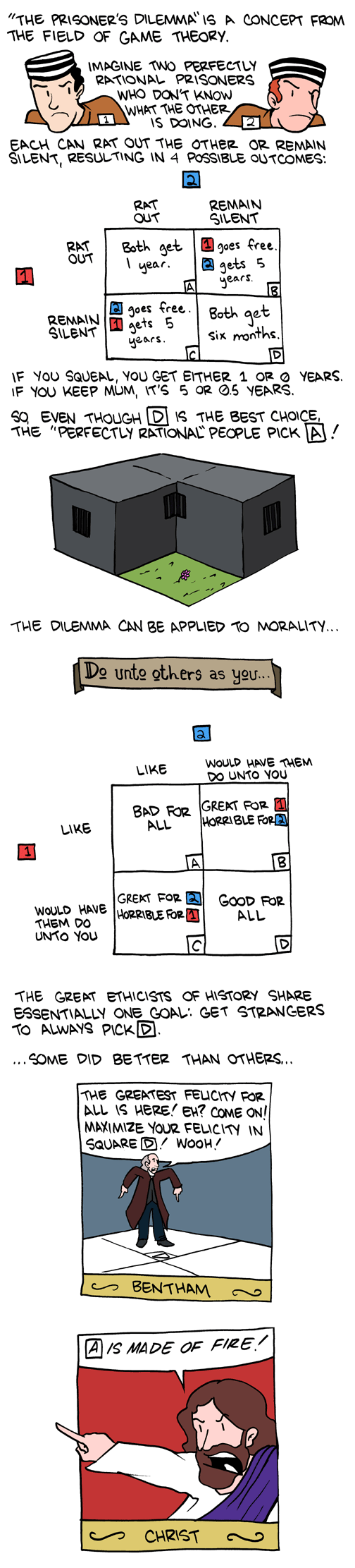
Found on Saturday Morning Breakfast Cereal, via The Astronomist, the cleanest illustration I've seen anywhere of the Prisoner's Dilemma:


The comic ends with a (brief) survey of attempts to convince people to act altruistically rather than selfishly. For me, the more interesting question is how to transform the structure of social interactions, so that altruism is the right choice for individuals as well as for the whole group.

Don't wait for superman

This weekend I saw "Waiting for Superman" a documentary directed by Davis Guggenheim of Inconvenient Truth fame.  It's ostensibly about how great teachers are the key to saving our education system.  But what struck me, over and over, was its complete lack of understanding of or regard for what teaching actually entails.

There are many, many problems with this movie, and I will not discuss them all.  A website has been set up to debunk it, and on the Daily Kos a classroom teacher provides something of a point-counterpoint.  (I should add that I do not necessarily endorse everything said on these sites.)  I focus my critique on the movie's conception of teaching, because that's the aspect which clashes most directly with my three years' experience as an urban public school teacher.

My first two years were at the now-defunct Austin Community Academy in Chicago.  As an incoming math teacher, I had the good fortune of being mentored by math department chair Steve McIlrath, one of the most amazing and inspiring educators I know.  On the day I was hired, he told me was "This may be the most difficult job in America.  Every teacher who works here is a hero."

I didn't quite believe him then, but after the first month I knew exactly what he meant.  The teachers at Austin were not all amazing educators (especially not me).  They were not always flawless in their classroom management or sophisticated in their pedagogy.  Personally, I was horrible at classroom management and cringed at my own pedagogy.  But just the action of coming in every day to face the students---who were facing their own enormous life challenges---and putting in the effort to manage, engage, and educate them was herioc.

I don't have space to describe how incredibly difficult it is just to be a struggling teacher at these schools, let alone a successful one.  If you haven't been there, you don't understand.  You can, however, educate yourself through memoirs such as In the Deep Heart's Core, Reluctant Disciplinarian, Chasing Hellhounds, or (ironically enough) Guggenheim's first film The First Year.

Waiting for Superman (WfS) at times acknowledges that teaching is difficult, and that teachers are a "national treasure".  But it includes zero interviews with current classroom teachers, and promotes an absurd notion of what teaching is actually about.  In one telling moment, a cartoon depicts teachers opening up students' brains and pouring "knowledge" in from a carton.  This, we are told, is the way education is supposed to work.  Except that now all kinds of standards and regulations have been instituted by various bureaucracies.  This multitude of regulations confuses the teacher, who then spills her precious "knowledge" onto the floor. 

If this is your picture of teaching, then we can't even begin to talk about education reform.  It's not an oversimplification, it's just plain wrong.  Educating students---getting them to absorb and engage with new ideas---is what makes teaching hard.  This is especially difficult in urban districts where it can be difficult to get students to show up to class, let alone sit politely and receive your teachings.  There is no magic carton.  Even if there were, students are not mere knowledge repositories but active, thinking beings, and they should be taught as such.  Sure, I was operating under many layers of regulation, but these were largely irrelevant to me.  What mattered in that room were me, my students, and how I was going to teach them.

WfS's main suggestion for improving our schools is to remove tenure protections so that deadbeat teachers can be fired.  These deadbeats are definitely out there.  One of them occupied the room right next to Steve's.  His idea of music education was to let his students listen to the radio, all day, for the entire year.  People like him are criminals.  It's deplorable that union contracts prevent the firing of such teachers.  I absolutely agree that blanket tenure should be abolished, though there should still be mechanisms to protect teachers from the whims of vindictive principals.

But WfS seems to suggest that removing tenure is the magic bullet needed to fix our education system.  This assumes that for every deadbeat fired, there is an excellent teacher waiting in the wings to be hired.  That's not the case.  As Geoffrey Canada acknowledges during the movie, every excellent teacher starts out as a struggling teacher like I was.  These struggling teachers must be thoroughly trained and mentored before and during their first year.  All teachers must be given manageable class sizes and courseloads, as well as time to collaborate with their colleagues.  They must be given excellent textbooks and other classroom resources.  They must be well-compensated so that quality talent is attracted.  Schools must be better integrated with social services so that students are healthy and in class every day.  Teachers' unions have an important role to play in advocating for teachers' rights and quality of life.

All these reforms are necessary so that struggling teachers can become successful rather than leave the profession (as half do within their first five years).  But WfS suggests none of these.  Instead, it asserts that all we need is to make teachers more accountable.  Trust me, I was already trying as hard as I could.  More threats hanging over my head would not have improved my teaching. 


Worse, the movie promotes the dangerous idea that we can fix public schools without investing in them.  It claims we "tried" spending money and it didn't work, so now we should try something else.  This is horrible logic.  All of the above reforms require money, along with a good plan for using it.  I'm terribly afraid that for years to come, conservatives will cite this movie in their crusade against government spending.  Meanwhile, our public schools will continue to languish underfunded.

In short, WfS promotes an absurdly simplistic view of teaching, in which teachers are either good or bad.  As soon as we fire the bad ones, we will have only good teachers and top-quality education.  This ignores the reality for the vast majority of teachers who are trying but struggling.  These teachers are performing one of the the most important and difficult jobs in the country.  They need to be supported, and their jobs made more manageable, in order for them to succeed. 

I could go on about WfS's other flaws: its bizarre use of pop-culture references (School of Rock??), its incomprehensible reverence for No Child Left Behind, its use of schoolchildren as emotionally manipulative props, etc.  But I'll end with this thought: in the closing credits, we see the text "The problem is complex.  But the solution is simple."

Take it from a complex systems theorist: this is rarely the case in any context, and it's certainly false when it comes to education reform.

Inside the Mathematician's Studio

One of the aims of this blog is to give the general public a sense of what we applied mathematicians and other non-laboratory scientists actually do with our time. An earlier post addressed the content of what we do: the development and analysis of models. This post, on the other hand, will focus on process. Specifically, my process: how I actually do math.  This post is a joint project with my partner Anna, whose beautiful sequence of illustrated text about the nature of the creative process appears on her site drawmedy.

Of course, there are many aspects of what I do. Activities such as reading through the literature, meeting with collaborators, and writing up results, don't require much explanation. I focus here on the parts of my job that makes me feel most like a mathematician: coming up with new ideas and developing them into mathematical arguments.

It starts with a problem. Most often I'm trying to prove some result of the form "In this model, under these conditions, this kind of behavior can arise". Sometimes these questions can be addressed using textbook-style sequences of steps, or even using programs like Mathematica. But such straightforward solutions don't interest me as a mathematician, and I like to leave this kind of work to other people. What really makes me come alive are the questions for which new mathematical approaches must be conceived.

This is an inherently creative process. There is no way of knowing at the outset what the solution may look like, or even whether a solution will be found. All you start with is your toolbox of mathematical techniques, and some hunches about which tools might work if applied correctly.

From this starting point, it's a process of trying approaches, failing, trying other approaches, asking questions, re-framing the problem, working out simple examples, and trying to make connections between different areas of my knowledge. This process plays out in pencil scratchings on my bound notebooks, two pages of which I've reproduced here:

These two (non-consecutive) pages show some of my musings on Prisoner's Dilemma games played on networks.   On the first page I'm mainly working through some visual examples.  You can also see some of the general questions these examples inspired. ("Maybe this is all about...")

The first half of the second page shows me asking questions (indicated by the Q:) and formulating hypotheses about how different models might be connected.  I typically jot down my thoughts in real time as they occur to me, so that it almost feels like journalling.  I tend to write in complete sentences, but sometimes a thought will end mid-sentence as something else occurs to me.  I'll also go back and write in the margins (e.g. the circled questions at the top right of the second page) if I have an idea that connects to something I wrote earlier. 

The second half of the second page shows some calculations as I test one of the hypotheses generated above.  Note the circled line with the words "NOT TRUE" to the right.  Mistakes and retractions are ubiquitous in my notebooks (as they probably are in the scratchwork of most mathematicians).

My favorite position for such notebook-scribblings is reclining in a couch or comfy chair, as Anna deftly illustrates:

I tend to get antsy when sitting upright for too long. In fact, I'm a big fan of changing scene in general. If I'm stuck in one room with no good ideas, I'm liable to go searching for another room to work in.  Perhaps this helps me get a new perspective on what I'm doing, or maybe it just stops frustration from building up.

I should add that many of my best ideas actually come in the shower, or jogging, or in other situations where my brain has the time and space to chart its own course.  Other mathematicians I've spoken to share this experience.  If you've been focusing on a single problem for long enough, it can seep into your subconscious, which may continue to generate ideas even when you're doing other things.  Back in college (when I was a pure mathematician) I even got to the point of solving homework problems in my sleep, though the sleep was not exactly what you'd call "restful".

I'll end with a call to other science bloggers and writers.  The Paris Review, since the 1950's, has conducted a series of interviews with world's preeminent writers on their process: how they generate their ideas and shape them into finished pieces of writing.  Collectively, these interviews have helped shape public perception of writing as an occupation, and illustrated the variety of methods that writers employ.  In this age where science is increasingly misunderstood and distorted in the public eye, I think it would be powerful to have a similar series of documents illustrating the daily processes of scientists.  So I'd encourage any science bloggers/writers reading this to consider expressing your own personal "scientific method" to the general public, and pass the word along!

Eusociality and a blow to kin selection

A new paper hit the internet today. "The Evolution of Eusociality" by Martin Nowak, Corina Tarnita, and E.O. Wilson re-frames an old evolutionary question and strikes a blow in an increasingly heated debate.

Eusociality is when individual organisms act as a collective reproducing unit. The best-known examples are ants and honeybees, but recently discovered examples include certain beetles, shrimp, and mole rats. Typically all reproduction is done by a single queen, and the rest of the colony exists only to support and protect the queen. Eusociality represents the highest degree of social organization found in nature.

The evolutionary origins of eusociality are something of a puzzle. To transition to eusociality, individuals must give up their own reproductive potential to support that of the queen. This is the ultimate sacrifice, as far as evolution is concerned. If evolution favors those who produce the most offspring, how can it select for actually giving up the chance to reproduce?

The classical answer to this question is kin selection: the idea that cooperative acts can occur between close relatives. Dawkins explained this using the concept of "selfish genes" that promote cooperation with others who have the same gene. One proponent, J.B.S. Haldane, famously said he would jump into a river to save two brothers, or eight cousins.

Ants and honeybees, the two oldest-known examples of eusocial animals, have a special genetic structure in which siblings share 3/4 of their genes, as compared to 1/2 in most sexual reproducers. It seemed reasonable that these close genetic relationships made possible such large-scale organization and extreme altruism.

However, as more eusocial species were discovered, including mammals, this association fell apart. There no longer appears to be any significant relationship between eusociality and relatedness of siblings.

Nowak, Tarnita, and Wilson provide a new model which focuses on the competition between reproductive units, which can be individual or collective. But perhaps more importantly, they thoroughly deconstruct the mathematics underlying kin selection theory.

The big debate in evolutionary theory right now is between those who believe all cooperation can be explained by kin selection (in its more mathematical guise of inclusive fitness theory), and those who believe that the more standard natural selection concept has more explanatory power. This debate has become increasingly heated in recent years.

Backed by rigorous mathematics, the authors argue that
Inclusive fitness theory is not a simplification over the standard approach. It is an alternative accounting method, but one that works only in a very limited domain. Whenever inclusive fitness does work, the results are identical to those of the standard approach. Inclusive fitness theory is an unnecessary detour, which does not provide additional insight or information.

The import of this argument might not be apparent to those not immersed in the field, but this paper could be a turning point in how the evolution of cooperation is understood. Social behavior cannot all be reduced to selfish genes. There are in fact many mechanisms allowing cooperation to evolve. Understanding these mechanisms will continue to be a fascinating question in evolutionary theory.

Is a new mode of evolution emerging?

Evolutionary theorist Susan Blackmore argues in the New York Times (and elsewhere) that a new form of evolution is emerging, based on the replication of digital information.

This would be the third mode of evolution that we humans are aware of. The first is, obviously, the biological evolution of life. Organisms grow according to DNA blueprints, then produce offspring from copies of these blueprints, perhaps with some variations. Competition between variant copies drives the evolution of life as we know it.

The second mode of evolution is cultural. Ideas spread from person to person, and through this process, whole cultures evolve. Richard Dawkins coined the term "meme" for the units of cultural evolution (i.e. the ideas that "replicate" themselves in people's minds), analagously to genes in biological evolution. Blackmore is a strong proponent of the meme concept, but there is much debate over the utility of this idea in explaining cultural evolution. In any case, it is clear that there are major differences between how biological and cultural evolution work. Understanding and quantifying these differences is a major project for evolutionary theory, and I hope some day to contribute to this effort.

Blackmore calls her proposed third mode of evolution "technological", but "digital" might be a more precise term. Every day, millions of files (encoded in binary) are copied from one location to another. Some files are even programmed to copy themselves. But copying isn't always perfect, and sometimes copies differ slightly from the originals. If these variant copies compete for the ability to reproduce, might we witness a whole new form of evolution in which the "organisms" (which Blackmore calls "temes") are purely digital?

One reason this idea is compelling to me is it follows a pattern of symbolic representations driving changes in the evolutionary process. Biological evolution took off with the advent of DNA/RNA encoding, in which the characteristics of an organism were recorded in an easy-to-copy format. Written language isn't necessary for cultural evolution, but it sure helps. It is much easier to copy the blueprints for, say, a motorcycle, and build new motorcycles from the copied blueprints, than it is to build a new motorcycle by observing an existing one. Symbolic languages facilitate the copying process which is essential for evolution.

Binary is one of the most powerful symbolic languages ever, with the potential to encode almost anything. Binary is also extremely easy (for computers) to copy. It is therefore quite appealing to think that the copying of binary files could form the basis of a new evolutionary process. The artificial life community has been experimenting with this idea for several decades, and I am far too ignorant to comment on their successes and challenges.

I will say that, so far, I can't see much evidence of Blackmore's teme-based evolution happening outside of simulations. The closest parallel seems to be computer viruses, which can copy themselves from computer to computer and sometimes mutate along the way. But these viruses are all designed by humans, and I don't know of any that have evolved novel functionality on their own. Viral videos and other internet memes also rely on the copying of digital information. But the decision to copy such memes is made by humans, so this falls within the domain of cultural evolution.

Will we, in the future, see pieces of code that replicate themselves across the internet, compete with each other, and evolve toward increasing complexity? And if so, will we be able to harness this process for good? Or will it be a mere nuisance, like weeds or spam-bots? I'm not yet convinced that this will happen, but these are important questions to ask.

Update on Game-Based High School

I wrote a while back on a high school that uses games as its primary pedagogical tool. NPR's All Things Considered has a new report on the school. Excerpt:

"In math, we're traveling around the world," says sixth-grader Rocco Rose, a student at Quest to Learn and a citizen of Creepytown — an imaginary city where his class learns math and English. The students play travel agents, convert currencies, keep blogs about their travel experiences and budget trips.

Creepytown is structured like a video game that has jumped out of the computer. During their 10-week "missions," students learn to adapt and improvise.

"The second trimester, Creepytown went broke," Salen says. "They had ... an economic crisis. So the kids worked to figure out ... what had gone wrong. And then they proposed the design of a theme park to bring revenue in."

Systems Thinking

Salen says playing with complex dynamic systems gives kids opportunities to learn.

Students "learn how to solve problems, how to communicate, how to use data, how to begin to predict things that might be coming down the line," she says.

They also learn something called systems thinking, which Salen says is one of the cornerstones of 21st century literacy. It helps you understand how the behavior of a derivatives trader in Hong Kong affects housing prices in Florida. When a system becomes sufficiently complex, Salen says, you start to get outcomes that are hard to foresee.

"Suddenly you begin to get what's called emergent behavior, and in emergent behavior, that system, the elements in it, begin to relate to one another in ways that can be unpredictable," she says.

Hell yeah! If we can give the next generation early experience with complex systems and unintended consequences, there may be hope for the future yet.

Big Bang Big Boom

Evolution-inspired animated street art, and one of the most amazing works of art I've seen in any medium: